

IBBA International Committee Liaison
This event had been on hold due to Covid-19 postponing the originally scheduled 2020 event. However, waiting until 2023 did not disappoint as Brangus breeders from around the world travelled to witness the genetics showcase, network with fellow breeders, and learn more about the Brangus breed worldwide. The event hosted 100 foreign guests from 15 different countries including: Australia, Belize, Bolivia, Brazil, Colombia, Costa Rica, Ecuador, Guatemala, Mexico, Panama, Paraguay, South Africa, Thailand, Uruguay, and the United States. “Our drive [hosting WBC] was not only to host as many participants as possible from all over the world,” Ing. Hernán M. Magaz, AAB Manager stated, “but also, that each one of them really lived a unique experience: appreciating the Brangus in different real production systems and in a sustainable natural environment.”
The tour of regional ranches for WBC started April 19 and lasted for 6 days, concluding April 24. Over 300 people registered for all or part of the tour. The first stop was at Establecimiento Las Marías in Virasoro, Corrientes, which is in the subtropical climate that has no dry season. Rodolfo Peralta gave a technical talk at the ranch regarding the selection of females based on adaption requirements. Las Marias is a breeding farm focused on production. Their current herd consisted of 141 pregnant cows, 50 cows with calves at side, and 300 finishing steers. They make selection and improvements based on classic phenotypes, EBVs, and pedigree. Fertility is not prioritized during adverse conditions. “The tour of the different Cabañas was great and was a learning experience where we gained a lot of knowledge and information that will be used at our cattle farm,” said Guadalupe Dyck of Irish Creek Ranch in Belize. “What really motivated us was that the cattle farmers were very open and willing to share their experiences and offer guidance in certain areas.”
Cabaña Itá Siri located in Desmochado, Corrientes, was the second stop on the tour. Since 2005, Itá Siri has the unique selection model of “always” culling open cows and first service heifers who do not present a calf at the end of the calving season. “The ranch hosts, a fundamental part of the project and committed from the beginning, have made an unparalleled effort after going through a climatic context of extreme and unprecedented drought,” said Magaz. “This did not stop them from entertaining their visitors who during the tour were able to share experiences with colleagues, listen to technical talks, enjoy the cuisine offered, and above all, marvel at observing thousands of Brangus cattle in the fields.” Cabaña La Victoria located in Esquina, Corrientes, was the third stop on the tour. The ranch currently operates with 9,000 breeding cows and produces their own replacement heifers and bulls that are either sold as breeding stock or finished in feedlots. This was the first large scale production ranch to visit as well as to observe the implementation of pine trees with grazing pasture. Dyck stated, “We were very impressed with the Brangus genetics that we foresee ourselves having in the near future by importing embryos and semen.”

All Brangus association representatives from around the world joined a meeting to discuss their country’s current climate, Brangus initiatives, research projects, future goals, and accomplishments since the previously held World Brangus Congress (2020). – Photo courtesy of Daniel Sempé
The IBBA delegation that attended WBC consisted of: Allen Goode, IBBA Board Member & Past President along with International Committee Vice Chair; Briana Hicks, IJBBA President; Jeremy Jackson, Board Member & Past President; Darrell Wilkes, IBBA Executive Vice President; Enrique Crotto, TDA and USLGE consultant; and Macee Prause, IBBA International Committee Liaison. Our delegation arrived halfway through the tour and started at Estancia El Bagual in Presidente Yrigoyen, Formosa. The ranch focuses on production in harmony with the environment. The El Bagual tour started with an environmental stewardship presentation from the University that is using the ranch to research insects and termites followed by a heat stress effect and EPD presentation. El Bagual uses 50% artificial insemination and 6% embryo transfer on their 100% grass-fed herd. EIDs are given to all calves to have traceability and to be registered through TrueTest DataMars.
The following day, we visited Estancia La Leonor in Presidencia Roca, Chaco, whose family also has a renowned steakhouse in Buenos Aires. Their herd consists of 7,000 cows, of which, 63% are artificially inseminated. “I’ve always known that Brangus cattle are the perfect fit for a vast array of grazing lands situated in harsh environments all around the globe, but the reality of that really sunk in as I had the pleasure of visiting with folks from Thailand to Australia to Panama and Brazil,” Wilkes stated. “We all have the same challenge – raising cattle that are adapted to harsh environments but still producing high quality beef.” Rodolpho Canta with La Leonor expressed that the use of genomics in their selection process has been helpful in maintaining their true Brangus percentage as they find their ranch’s percent indicus average is roughly 66%.
The tour concluded with Cabaña Los Guasunchos in Santa Margarita, Santa Fe, which was the largest ranch to visit with over 20,500 head made up of 60% registered Brangus with 90% of those being Red Brangus. The first presentation at Los Guasunchos was to give insight to their ranch limitations. They have more problems with lack of water than lack of forage along with salinity issues. To combat this issue, they have a desalination plant and do reverse osmosis onsite to generate drinking water. Because of these conditions, they need cattle that can tolerate a harsh environment. Brangus are an excellent fit as they are able to meet all adaptability requirements. Goode said, “It is an eye-opening occasion to realize how much our Brangus cattle and genetics contribute to the global beef industry.”

The Federation of International Brangus Associations (FIBRA) met to vote on the next two World Brangus Congress’ along with discuss improvements that can be made to the organization structure. Photo courtesy of Daniel Sempé
Goode was able to see just how much of an impact his ranch has made when viewing TRIO genetics at Los Guasunchos. Additionally, the ranch goal is to be objective and not subjective in selection, and to find balance in EPDs that go with their production platform.
The next morning, prior to the start of the afternoon exhibition, all Brangus associations gathered to give presentations regarding each country’s current environment, breeding goals, market plans, research, membership, and potential networking opportunities. Martin Lill with Viamonte Brangus presented for Australia. Their business consists of 80% Black Brangus and 20% Red Brangus. They do not use as many red due to the increased competition with other red breeds. They are currently seeing Ultras increasing in popularity in Australia, high livestock prices, high land prices, and higher use of GPS tracking of cattle on farms. Australia Brangus Cattle Association is the 8th largest registered cattle breed in Australia out of 44 registered breeds and has registrations with 6,600 head recorded in 2021. They had methane emissions incorporated into BreedPlan and are looking to add Slick Coat gene markers to their DNA bundle.
Abram Froese from Belize presented the current challenges the country is facing as beef is a new market mostly consisting of Zebu-type animals. He assisted Belize with obtaining a clear health status to allow export marketability and is currently working on promoting the breed in Belize in order to improve their domestic herd and potentially form a Brangus Association in the future. Bolivia Brangus Association said they are small but growing thanks to the FSC agreement for Brangus use in the country. Then, Angus & Brangus Colombia followed with their focus on Brangus that have more indicus influence due to climate adaption requirements for their country. After, AsoBrangus Costa Rica was excited to present their herd growth of 2,100 registered Brangus and 10,000 head with commercial Brangus after only being founded in 2014. They also just started an EPD program with their University to offer more selection opportunities and exportation abilities.
Ecuador Brangus expressed the need for breeds with higher quality beef due to 70-80% beef being kept domestically, and currently, 3,000 registered Brangus cows. Asociación Mexicana de Criadores de Ganados Brangus presented the Brangus breed’s expansion across the country; with 6,000 registered head per year and 274 members, they are looking at a bright future. Followed by, Asociación Brangus Rojo de México who is celebrating their 20th anniversary with their 170 members. After, APANGUS in Panama presented its founding in 2007 supported by the ministry and invited attendees to join them at Panama’s national show. Then, Paraguay Brangus association, founded in 1983, has elevated their status in their country as 40% of the total herd population and placed an emphasis on producing Brangus beef.
Thailand was the newest association in attendance and is celebrating their 5th anniversary consisting of 200 members. Next, Brazil presented their video for the 2025 WBC featuring the huge business semen has in the country due to large scale crossbreeding the domestic cattle. IBBA followed with a video presentation that showcased the increasing Ultra registrations, genetic competitiveness in the U.S., ongoing research projects, genetic evaluation, and partnerships in the evaluation, FIBRA, upcoming 75th anniversary, and IBBF International Education Scholarship. Wilkes said, “Whenever the topic of a global genetic evaluation for Brangus was brought up, there was keen interest. I know it is not a small hill to climb to achieve a global evaluation, but it was clear to me that the interest level is very high, and the rewards could be highly significant for owners of superior Brangus genetics.”
The World Brangus Congress showcase was presented as part of the 53rd Great National Exhibition and the 17th National Calf Exhibition. There were approximately 540 Brangus entries from 12 different provinces of Argentina consisting of 77 registered ranches with 11 of those being first time participants. Additionally, the Rural Society of Corrientes exhibition ground featured the release of the “covered shed” with a space of 1,800 m2 built specifically for hosting WBC and future events. IBBA members Marcos & Adriana Borges with MBJ Ranch, Gerardo & Melissa Alanis with South Texas Sendero Ranch, and Garrett Thomas, IBBA International Committee Chair, joined our delegation at the exhibition to witness the genetics showcase. “By focusing on the strengths of the breed rather than personal agendas, there is immense potential for the Brangus breed in the US and around the world,” Marcos Borges said. The judge for the WBC exhibition was Carlos Ojea Rullán along with secretaries to the judge, Javier Mendoza and Garret Thomas. Rullán praised the work of the Argentine Brangus breeders and the contribution they are making to not only the breed, but also the livestock industry in general. “It is very difficult to get bulls in all breeds, and I think that in Brangus, it is the best closing of bulls that I have had to see,” Rullán stated during the Championship selection.
“Working alongside Carlos Ojea judging the World Brangus Congress was a once in a lifetime opportunity,” Thomas stated. “During the show, we discussed the differences in cattle from the US and Argentina while identifying common ground in selecting Brangus cattle that would thrive anywhere on the globe. Evaluating nearly 1000 head over three days was an eye-opening experience that gave me a new perspective on the Brangus breed, and it highlighted how big of an impact our breed can make on the global beef industry.”
IBBA had additional representation in the show ring as Briana Hicks was afforded the honour to show some cattle for El Destino at the WBC exhibition. “Attending the World Brangus Congress in Argentina was the trip of a lifetime,” Hicks declared. “Being able to experience the beautiful ranches, excellent hospitality, friendly people, and awesome cattle is a memory I will cherish forever. I had the honor of exhibiting a few cattle for El Destino. Our breed is truly adaptable and functional in a global market, and I am excited for the future of our breed!”
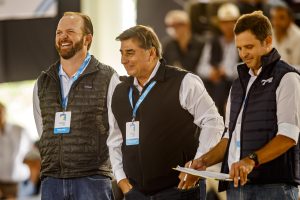
Garrett Thomas, IBBA International Committee Chair, received the honor of Secretary to Judge and is pictured with World Brangus Congress judge, Carlos Ojea Rullán, and secretary to the judge, Javier Mendoza. Photo courtesy of Daniel Sempé.
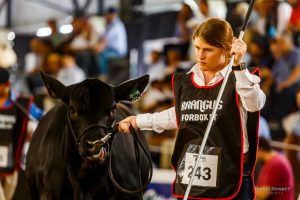
Briana Hicks, IJBBA President, showed animals for El Destino Brangus in the Argentine World Brangus Congress arena. Photo courtesy of Daniel Sempé.
The FIBRA, the Federation of International Brangus Associations, meeting was held following the conclusion of the exhibition. The main purpose of FIBRA is to schedule the World Brangus Congress, but also, to promote Brangus worldwide. IBBA hosted the previous FIBRA meeting in December 2019 as a post-WBC 2018 event. Due to Covid, FIBRA has not had in-person meetings, so this was the first scheduled meeting following that event. Marcos Borges was able to present the importance of FIBRA, its founding, and future goals. Many discussions were made at the meeting including having a central database between associations, election of the upcoming WBC host – Brazil – as the President, proposal for 2029 WBC host – Paraguay, proposal that future WBC change continents for each event, and to create an environmental stewardship committee. As President of FIBRA, Brazil Brangus Association’s President, Ladislau Lancsarics Jr, will be lending the charge to coordinate the next FIBRA meeting and subsequent meetings at WBC 2025. Marcos Borges said, “The excitement is building to organize this epic event in Brazil, given the volume and size of Brazilian Brangus operations.”
The last day of the exhibition concluded with an evening gala, closing ceremony, and sale. Multiple presentations were given with the first being the Welcome address from the President of the Argentine Brangus Association (AAB), Victor Navajas. Martin Goldstein, President of the AAB WBC Organizing Committee, gave a tribute presentation for Martin Garcia Fernández, first Vice President of AAB who recently passed prior to the realization of the 2023 WBC event in Argentina. “We had a chance to participate in all the World Congress’ and this year in April, Argentina World Brangus Congress was a remarkable example of the passion and commitment of Argentinian breeders to promote and support the Brangus breed in their country,” Marcos Borges stated.
The WBC sale featured many high selling lots including the Grand Champion bull that sold 50% interest for $38.5 million Argentine pesos [$85,000 USD], and the Reserve Grand Champion female that sold 50% interest for $31 million pesos [$68,000 USD]. The sale included not only all the attendees from WBC & Rural Society of Corrientes, but also over 10,000 registered buyers online. Registered bulls averaged $1,538,000 Argentine pesos [$3,375 USD], and registered heifers averaged $1,671,875 Argentine pesos [$3,670 USD]. IBBA Past President, Jeremy Jackson said, “I enjoyed the whole experience. Honestly, I didn’t know what to expect since I had never been out of the country to sort cattle. The cattle were great. The hospitality was great. I’m already looking forward to WBC in Brazil in 2025.”
World Brangus Congress is a Brangus event like no other. It is a chance to learn more about the breed in different regions of the world, expand your network and marketing objectives, see different genetics adapted to different climates, discover different principles and practices that you may decide to implement at your ranch, and last but not least, become a part of the global Brangus family. McKean said, “My favourite part is catching up with friends here because they are family.” That could not be more true. WBC brings breeders from across the world together every two years to celebrate, showcase, and demonstrate the passion we all have for the Brangus breed. “Every Brangus breeder can learn and gain from attending and experiencing a World Brangus Congress,” Goode said. “There is the adventure of traveling to another country and enjoying their culture, but then there is the common collegial community with a passion for Brangus cattle and genetics.” IBBA would like to thank AAB for hosting such a great event and the hospitality received from the Argentine breeders. We look forward to gathering at the next WBC in Brazil 2025.
ANY COUNTRY IS BRANGUS COUNTRY!
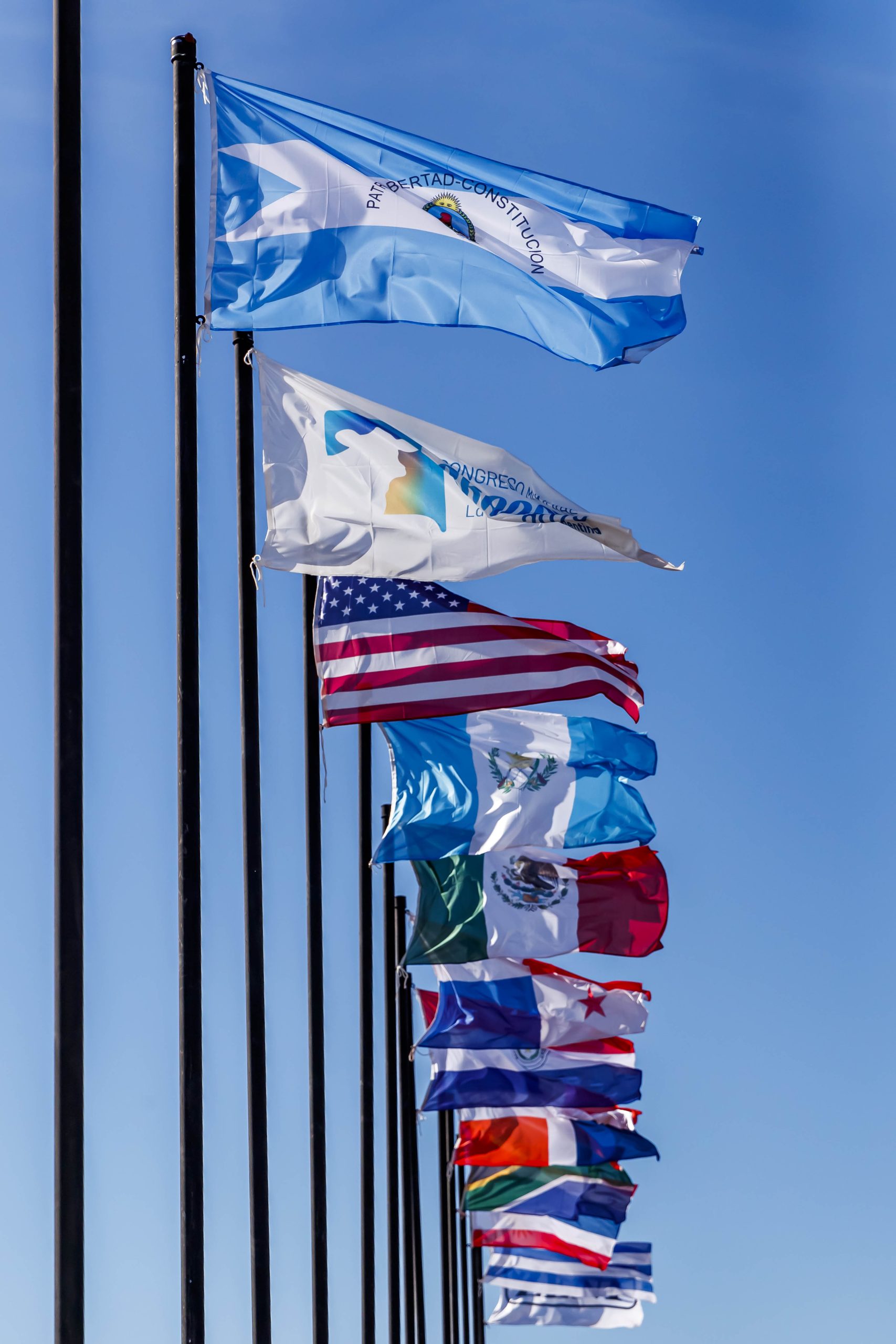
Photo courtesy of Daniel Sempé.